Steve Rader
November, 2026
The Universe has decided that I should not lift more than 10 pounds. Let me explain. About a year ago I was diagnosed with a dilated aorta. I had no symptoms, just an extremely thorough doctor. My aorta is slightly enlarged for unknown reasons. Once it’s enlarged a specific amount, it is referred to as an aortic aneurism. A ruptured aortic aneurism is what we want to avoid. Comparatively, my enlargement is not so large. Nevertheless, I need to keep it that way. In discussions with my cardiologist about activity restrictions, I was told that I can do as much cardio as I want but shouldn’t lift more than 10 pounds. This was very painful advice to get.
About three weeks ago I woke up to subtle flashes of light in the periphery of my left eye that occurred upon eye movements and blinking. Thinking this was transitory I didn’t worry until I noticed a large increase in floaters in the same eye. A quick web search indicated that I needed to get to the ophalmologist as soon as possible. I did. She dilated my eye and scanned my retina and diagnosed me with Vitreous Detachment, something that occurs fairly commonly with age. Her scans indicated no retinal damage. She said the condition would resolve once the vitreous was completely detached and I would go back to something like normal.
A day or so later I noticed a small shadow or blind spot in the lower left corner of my eye. Again, knowing this to be a bad sign, I went right back to the ophthalmologist. She did another scan and said that I had two small tears on my retina. I was instructed to go to a Retinal Specialty office where they would be able to correct the problem. I got the first available appointment there, which was a few hours after my opthalmology appointment. The doctor scanned my eye and told me that I had a full detachment and that I would need to get surgery as soon as possible. Crushing news. I got the surgery at Johns Hopkins Suburban Hospital the following evening.

Recovery has been slow and limitations severe. For example, I had to lie on my stomach for three days. After that I could walk a bit but otherwise had to rest and was only able to sleep on my right side. A week or so later I was allowed light activity, which included walking and, you guessed it, lifting no more than 10 pounds. No driving, no bike riding, no vigorous activity of any kind.
Is the 10 pound limitation coincidental? No, but it sure is arbitrary. The point is to avoid an activity that causes you to strain. Of course, 10 lb is heavier to some people than it is to others, but it’s nowhere near heavy enough to cause what is the real danger – a highly engaged core, or the Valsalva Maneuver. Think what happens in the middle part of your body when you are attempting a max deadlift. Holding your breath, core incredibly tight, face red, etc. Further discussions with my cardiologist revealed that the Valsalva Maneuver is in fact what I am to avoid and not necessarily lifting more than 10 lb. That is just a guideline that most people will understand.
Again, as a calisthenics practitioner, this is all terrible news for me. Until I looked further into it and thought about it. What really is to be avoided is an effort that requires holding the breath and heavily engaging the core. In other words, if you can breath while doing it, it is probaby ok.
I am a good patient and wanted to follow the doctor’s advice as closely as possible, especially after the detached retina, which was terrifying. So after a week when I was cleared to lift no more than 10 lb, that is what I decided to do. But how to do so and get anything at all beneficial out of the activity? Well, I was able to figure it out, and discovered some pretty exciting and useful things along the way. Here is what I recommend if you are facing these kinds of limitations.
Focus on What you CAN Do and Not What you CANNOT DO
If I can only lift 10 pounds then that’s better than no lifting at all and it’s better than five pounds and it’s something. So I’m going to lift 10 pounds and I’m going to figure out how to make it worth my time.
Spend some time doing some reasearch on how to get an effective workout with one 10 pound dumbbell and/or two 5 pound dumbbells. There are lots of ways and you likely hadn’t thought of most of them. A big part of my workout motivation comes from learning about others, past and present, who have done great things with whatever I’m limited to doing. A bit of searching quickly led me to the Bronze Era Physical Culturalists. These guys operated from the late 1800s through the 1930s or so and include people like Eugen Sandow (the “Father of Modern Bodybuilding”), Bobby Pandour, George Hackenschmidt, and Otto Arco. They developed incredible physiques that intentionally modelled the statues of the ancient Greeks, and they did so primarily through bodyweight movements, ring gymnastics, odd lifts, and light dumbbells. They were masters of “muscle control” and were able to flex and relax specific muscles. Some of them built incredible physiques without lifting weights at all.
Specific to this discussion was Eugen Sandow’s “Light Dumbbell System“, which used 5 lb dumbbells and a series of exercises to be performed every day with very high repetitions (up to 100 or 120) per set. The practitioner was instructed not to increase the weight but to focus intensely on the muscles being worked and to grip the dumbbell very hard. This system was sold to the masses and this may have something to do with why the weights recommended were so light. Nevertheless, Sandow performed the program every morning and had a remarkable physique. This was motivation for me.
But lifting 5 lb dumbbells for 100 reps can be boring and feel very unproductive. It is easy to lose sight of the focus and purpose while counting reps and wishing you could do more. So I worked to improve the methods to suit my needs and preferences.
Stick With Unilateral, Isolation Movements
Since I was allowed to lift 10 lb I stuck with a single 10 lb dumbbell or a 10 lb plate on my pulldown pully system. This forced me to perform all exercises unilaterally, which proved to be beneficial because it allowed me to focus on the muscle being worked and it doubled the overall amount of movement I was getting. That’s a good thing when your activity is so highly restricted.
We are living in the golden age of compound movements and these days unilateral or “isolation” movements are often frowned upon or made fun of. Single joint movements are for bodybuilders and take too long and blah blah blah. Sure. But there’s a reason bodybuilders use them and you don’t have to be a bodybuilder to have the same reason. They really allow you to focus on the muscle. Furthermore, gurus like Vince Gironda often favored them as his focus was on the overall appearance of the physique and the lines of the body. He felt heavy compound lifts made the body too thick in the middle and therefore took away from the aesthetic goal. You may tell me that you don’t care about aesthetics but I wouldn’t believe you. Nevertheless, there is something here that I can do. Additionally, I found it very easy to perform the sets without straining or even breathing heavily, and I concentrated on exhaling during the lift and keeping all other muscles relaxed but the one being worked. This set my mind at ease, relatively.
Slow Your Tempo. I Mean REALLY Slow
A slowed tempo is a great way to make any lift more intense and force good technique and focus. REALLY slow tempo is even better. I played around with going as slowly as I possible could on both the positive and the negative of the movement and not relaxing on either side. This brought my rep counts per set down to 3 – 6 and when I started timing the sets I was at 2 to 5 minutes per set. This intense and you are shaking by the second rep. There is absolutely no way to cheat these. And if you compare the time it takes to do 3 sets this way the the time it takes to do three sets of 12 or even 20 with conventional pace (1 second positive, 1 second negative), you quickly see that you are spending double or even triple Time Under Tension with the super slow reps.
Track Time Under Tension and Not Sets and Reps
If a set takes 2 to 5 minutes, it’s really easy to lose count. Fortunately, it doesn’t matter. Rep counts really are meaningless when you do your sets this way, and it’s very easy to ignore the numbers. Keep the timer going and visible and once you hit your target time and are pretty sure you can not do another rep without speeding it or cheating it in some way, the set is done. I often found that 2 sets per exercise were enough. This would give me 6 to 15 minutes under tension for each muscle. For comparison, 3 sets of 20 reps done at normal pace is two total minutes under tension.
Really Focus on the Mind-Muscle Connection
Remember what you are doing and why. The point is not to lift the weight or to lift the weight a certain number of times. The point is to work the muscle and force it to adapt by focusing specifically on it while performing the exercise. This is the Mind-Muscle Connection.
The Exercises I Performed (All Unilateral)
(I should point out that I was not allowed to lie on my back during recovery from retinal surgery, so anything resembling bench press or standard dumbbell fly or pullover was out of the question.)
Cable fly
Standing cross-body dumbbell fly
Straight arm lat machine pullover
Side lateral raise
Front lateral raise
Alternating dumbbell bicep curl
Concentration curl
Tricep push-down
Seated tricep overhead extension
Single leg extension
Single leg standing hamstring curl
Single leg seated calf raise
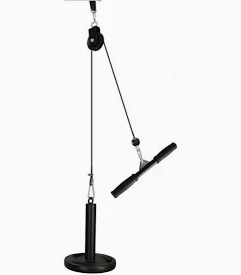
All cable fly and pulldown movements were done using this cheap and useful piece of equipment, which comes with different attachments.
What’s Next?
According to my doctor, next week I am allowed to resume my normal activities. But I intend to do so carefully and gradually. While I enjoyed my foray into light weightlifting, I am a calisthenics athlete, and am eager to get back to it. But with caution and intense attention to the movements I am performing, how I am performing them, and what’s going on with my core when doing so.
Are pull-ups a thing of the past? For many years pull-ups and chin-ups were my favorite exercise. A few years ago I did 20 chin-ups with pretty good form. I probably had a couple more in the tank.
But when asked what my favorite core exercise is, I often say pull-ups. Nothing engages the core better than a well executed pull-up or chin-up. And doing them over the last few months has been a little nerve-racking and always accompanied by the thought that I shouldn’t be doing them. That’s no way to exercise.
Fortunately I’ve grown to love a modified or assisted pull-up. I actually think it’s a superior movement for most of us who have not mastered the full bodyweight pull-up or have other factors preventing them from doing full bodyweight pull-ups. It lightens the load and allows a focus on the movement rather than getting over the bar somehow. It also allows you to take a load off the core.
Conditioning Is King
As I’ve said before, and especially as we get older, conditioning is king. Being able to last is far more useful than being able to lift a very heavy thing one time. I have a green light to do as much cardio as I want and while conditioning and cardio are not necessarily the same thing, conditioning is a way to bring strength training a lot closer to cardio and in my opinion is much more beneficial than training for pure strength.
This week I was cleared by my doctor to lift 30 pounds and I’ve been strictly adhering to this. Next week he said I can resume my normal activities, but rather than jump right back into full bodyweight calisthenics moves, I plan to ease my way back. A floor push-up involves lifting roughly 65% of your body weight. For a 185 lb person, that’s 120 lb. A big jump.
I plan continue what I’m doing now but with a 40 lb limit rather than 30 and then the following week move up to 50 lb. Then I plan to use gymnastic rings for pushing and pulling and to start with a very conservative stance so that the load is reduced significantly. If I am doing push-ups on rings that are high enough that the angle between my body and the ground is roughly 45%, then I am “lifting” approximately 84 lb. I’ll start with a slightly higher angle for both push-ups and rows and focus on high rep sets (at least 20) where my core is not engaged and I am able to inhale and exhale on every rep.
The Elephant in the Room
Another way to lighten the load in bodyweight calisthenics is to iterally lighten the load. Reduce body weight. DUH! I am not as lean as I would like to be and would really love to lose at least 10 lb of fat, preferrably 15. I believe many things will be improved beyond just the reduced stress while strength training if I did this.
In my next post, I will lay out the plan for this and will post progress as I go along. My current weight is 185 (5′ 11″) and my goal weight is 170. There, I said it!

