New Training Emphasis and a Funny Not-So-Funny Story about Eugen Sandow

I have shifted my training emphasis from strength and muscle-building to conditioning and endurance. Granted these are on a continuum so one is likely never done without at least some of the other. So, from a capped weekly volume of “hard sets” that reach mechanical and approach muscular failure, I have moved to high volume, low “rest”, “light” load daily work. There are several reasons for this.

Medical
For several years my doctor has been trying to get a handle on my blood pressure, which consistently reads from high to very high at medical visits to somewhat high to normal to even low at home. I have verified that my home machine is accurate. The main question is when does “white coat anxiety” bleed into hypertension, so to speak. My own sense is that most of the time my blood pressure is “normal”, but nonetheless, and out of caution, I take 3 meds daily and see a cardiologist regularly.

More importantly, an ultrasound and an MRI revealed a small aortic aneurysm. This is an enlargement of the aorta and a rupture likely means lights out. My enlargement is small, if that makes any sense. I was referred for genetic counseling and the counselor seemed mainly interested in whether or not any of my family members have keeled over suddenly and died. None have, to my knowledge. In fact, I know of no heart attacks in my family. The genetic counselor seemed satisfied with that information.

I am a healthcare analytics professional, and have tracked my BP for two years. I ran some descriptive stats on the data and found that my average bp is about 133 / 75, which is only slightly above current threshold for concern. My MD/Ph.D. cardiologist, excited by the data, said “this still needs to come down.”

The thing to avoid with aortic enlargement is the “valsalva” maneuver, or the intense engagement of the core. At great intensities this can spike the blood pressure very high and endanger an already enlarged aorta. The general advice is not to lift anything over 10 pounds and not to engage the core intensely. Struggling with a very heavy one-rep max deadlift or a bad case of constipation would be a very bad idea. Fortunately I have no involvement with either.

But think about pull-ups and other high load calisthenics exercises. I pressed my MD/Ph.D. cardiologist a bit more about exercise and the aorta at my last visit and he admitted that the 10 lb limit is not necessarly etched in stone, but avoidance of intense valsalva is. He also told me I am free, and even encouraged, to do as much cardio as I can. And lose weight. Roger that. Working on it. (SW 199, CW 180, GW 170).

I’m obviously not prepared to give up pull-ups and decline deficit push-ups. A little research indicated that intentional breathing during strength training can reduce or eliminate valsalva. I can make this work.

Goals
The medical reasons are enough to change my tranining emphasis, but in another important way, my goals are a big factor. At the age of 60, I no longer want to get bigger. I am satisfied with the amount of space I take up and don’t wish to take up any more. I want a “sleeper build”. And I feel the years I have left will be better spent with a stronger heart and lungs than neccessarily larger biceps. And my muscle mass is always cause for kudos at my physicals. “Money-in-the-bank” my doctor says.

So more movement and more “cardio” type movement is good all around. But keeping calisthenics exercises in the repertoire rather than, say, “becoming a runner” is also appealing and fits with the overall program.

Current Training
So the current training emphasizes overall time spent in challenging movement with little rest rather than sets-per-week at high proximity to failure with as much rest as needed between sets. EMOM training is a great example of this and fits into a larger category of “density training”. 20 bodyweight squats per minute for 20 minutes, for example. I try to challenge the whole body every day. Today I did supersets of 20 to 30 elevated pushups (against a bar just above waist high) to standing rows. I went back and forth without rest unti I’d reached 100 reps of each. I also did 200 reps of constant tension rest/pause “shorty” or “pulse” squats and 100 reps of rest/pause bodyweight Romanian deadlifts. “Rest/pause” means when the burn gets too intense, you stop for a few seconds until it subsides, then you continue. And just for giggles, I did a set of about 50 dumbbell curls (8 lb) supersetted with tricep presses and a superset of bent-over lateral raises into lateral raises for a total of 50 reps. I concentrate on breathing during execution of the reps. I ride my bike on average an hour a day and some days 2.5 hours total (commute to work and back).

The Eugen Sandow Story
After my first cardiologist visit, where I was told not to lift anything over 10 pounds, I was crestfallen. But determined to find SOMETHING to do, I reviewed some content on Eugen Sandow and his system of light dumbbell training. If you don’t know who he was, it’s worth spending time learning. In short, he was one of the first renowned physical culturalists and built an impressive physique using mainly 5 lb dumbbells and high repetition daily programming.

I don’t like moving dumbbells nearly as much as moving my body through space but this was enough to hold my depression at bay. So what’s the funny, not-so-funny story? Reviewing Sandow’s life a bit I discovered this little pertinent fact: he died in his 50s of a ruptured aorta.

GREAT!!!!! Well, we shan’t jump to too many conclusions here, and although the facts are a big fuzzy, it appears likely that he suffered the rupture after attempting to lift his car out of a ditch. You see, in addition to lifting tiny dumbbells, he did “feats of strength” often as a showman.

What I’m doing now feels good and it doesn’t feel dangerous, and more importantly, it feels beneficial all around. I admire anyone who can manage a 2.5x bodyweight deadlift, but I’ll admire from the sidelines.

The Food Pyramid Scam Scam

The food pyramid is not killing us. Social media and online life are killing us.

I’m a recovering ancestral diet enthusiast. What comes with enthusiasm for the ancestral diet and everything else that accompanies it is susceptibility to the belief that all of modern nutrition and in fact modern medicine are wrong and misleading us. Killing us. Well, I got over it. I now understand that my past interest in all of this had nothing to do with actual health and rational thinking and everything to do with a vulnerability to the messaging. “Question everything”, they say. Well, if you do that, you will spend your whole life questioning and no time answering.

The mindset that fuels the idea that the food pyramid is a scam and modern medicine is at the very least making us fat and at worst killing us is the mindset that seeks attention and clicks by drawing the dubious conclusion that, because the obesity epidemic exists in the same timespace as the food pyramid and modern medicine, the food pyramid and modern medicine must be wrong and have caused the obesity epidemic. We’ve all been lied to. So outrageous. To prove their claim would require that you can show that all those obese people have been following the food pyramid and the advice of modern medicine. Each and every one of them has chosen whole grains as the centerpiece of their plates, plates filled with vegetables, legumes, lean meats, low fat dairy, and fruit. They don’t eat fried food, sugar, or refined grains. They’ve gotten enough sleep, enough vitamin D, all the recommended vaccines, the right amount of social contact and weekly exercise. They don’t drink calories. They see the doctor and dentist twice a year. They floss. They reduced stress and have drunk enough water and used sunscreen consistently. They used alcohol in moderation. They’ve done all this and yet they’re all sick and fat and almost dead. Do you believe this? Or is it perhaps the case that the obesity epidemic and our collective sickness exist because the behaviors of the obese are nowhere near the food pyramid and the advice of modern medicine and therefore not related at all to their existence? (Which is, ironically, support for the value of the food pyramid and modern medicine.) And that something else has stolen their attention and driven their behavior? And what has stolen their attention has not so much driven them actively away from following medical and nutritional advice, but has simply precluded their ability to make any informed choice at all, because they are distracted?

Whatever grabs your attention the most times is all that matters now. A slow, methodical, science-backed approach wins races, but it does not win clicks. Clicks matter, how to win races does not matter. Health and longevity are won marathons and are not attention grabbers. They are not clickable. If I eat lots of vegetables, get enough sleep, drink a lot of water, exercise every day, and manage my stress, I will likely be healthy and live a long life. This is definiely true, even though you may disagree with it, and that cannot be disputed in a rational world. The only way you can legitimately disagree with it is to show evidence to the contrary, and that evidence does not exist, and not for lack of trying. But the methodical, science-based approach is boring and doesn’t matter to most people. SAYING that something will make you healthy and live a long life DOES matter to people. But what ACTUALLY DOES those things does not matter to people. Because those things take a long time, are boring, and do not generate clicks and buzz. And because they do not generate clicks and buzz, they force click-seekers to lie about what ACTUALLY DOES cause health and longevity. And guess what it is, according to them? The opposite of everything we’ve been told. Forget everything you’ve been told. The solution is actually much easier. There are hacks. Just do this. Works every time. (And they will sell you supplements, by the way.)

There’s only one way out of this and it’s to choose rationality and jump off the hamster wheel. Put down the phone. Go outside.

If any of this resonates with you, do me a favor and pay close attention to what you see the next time you look at your phone. The feeds from your preferred news sources and social media are a firehose of ads, lies, and garbage. Look at them closely. There is nothing of value whatsoever in them. Everything is designed to grab your attention, trick you out of your money, and compel you to keep looking.

B.F. Skinner was right.

Bibliography
In Defense of Food: An Eater’s Manifesto
, Michael Pollan, 2008
A Grain of Salt: the Science and Pseudo-Science of What We Eat, Joe Schwarcz, MD, 2019
Paleofantasy: What Evolution Really Tells Us About Sex, Diet, and How We Live, Marlene Zuk, 2013

I Can See Clearly Now

In two months I’ll be sixty years of age. I’ve been practicing calisthenics for fifteen years. But as much as I have preached the value of progressive work, I have not practiced it. Until now.

Everything came together for me a few years ago when I found Kyle Boggeman’s Youtube channel. He made what I had already been trying to do into an undersandable and worthy endeavor with scientific justification. Frequent calisthenics for building muscle, preserving joint health, and improving physical capability. He calls it “physiological hygiene”.

Kyle has a subscription service in addition to his Youtube channel. There you can view lectures that lay out in precise detail his core principles and how to apply them. You also have access to many assorted short lectures and recipes. The content is top notch and continually growing. The price is extremely affordable. I receive nothing to promote the service; I promote it because it is excellent.

After watching and rewatching the Core Concepts and the Applications lectures, I have divised a progressive calisthenics program for myself. I learned that the template is simple and outlines everything you need to do in order to grow stronger and more capable on your path towards mastery of the exercises. It’s almost ridiculously simple.

The method is roughly as follows: choose a few exercises within each of three movement patterns (push, pull, squat/lunge). The exercise variations should include different hand and feet positioning and difficulty. Establish your maximum repetitions with good form for a single set for each exercise. This is your Established Max. Determine your weekly volume and how you will split it up. The sweet spot for muscle building is 10-20 hard sets per week, and you can spread these over as many days as you wish while managing your fatigue and recovery.

Divise your workouts with the exercise variations you have chosen. Then spend a week performing the sets at four repetitions below your established max (4 RFEM). For example, I have chosen three exercises from each movement pattern: regular push-ups, decline parallette push-ups, close grip parallette push-ups, band-assisted pronated grip pull-ups, band-assisted ring pull/chin-ups, decline ring rows, weight-vest squats, walking lunges, and split squats. From these I have divised three separate workouts, each with three sets of the three movement patterns per day, six days per week. That’s 18 total sets of each movement pattern. So, for week 1, I am doing each set at 4 RFEM. In week two, it’s 3 RFEM per set, week three it’s 2 RFEM, and week 4 it’s 1 RFEM. After that first month, re-establish your max per exercise and start over. I intend to do this for twelve weeks, then I will choose new exercises and start the program over again.

As my maxes increase, I intend NOT to add weight to the vest or use lighter bands. I intend simply to add reps and once the pull-ups reach 20 reps with the band I am using, I will stop using the band entirely.

I also have created a Google Sheet that lays all of this out automatically. All you need to do is enter your exercises, your max repetitions, and the dates the workouts are performed. Each workout is then automatically populated. Email me if you would like a copy of the Sheet. It looks like this:

My ultimate goals are as follows: 10 paused-rep pull-ups, 30 push-ups, 100 walking lunges.

This almost feels like enlightenment. It’s just so clear to me now what to do and how to do it.

Maximizing Calisthenics Training Effectiveness for Strength and Hypertrophy: Three Pillars (Volume Reconsidered)

  1. Technique – I named my site “Form Is Everything” for a reason. While technique and form are not literally *everything*, well executed repetitions are incredibly important and key to progress and success. Take the push-up, for example. A small tweak in form can halve your maximum rep count and double the effectiveness of the set. So instead of a set of 35 “shorties”, increase the range of motion, lock out, and lower your tempo. Suddenly a set of 20 is difficult and far more stimulating.

    How to insure good technique? Increase your range of motion by locking out and/or using rings or something similar, and most importantly, pause your reps. Hold your position for a second at the top of a pull-up or row, at the bottom of a push-up or dip.
  2. Intensity – how difficult the set is largely determines how effective it is at building strength and muscle. While easier sets can have their value, hard sets build muscle by recruiting more muscle fibers. Without a density approach, easier sets will be much less effective. If a set taken to complete failure (another repetition would not be possible) has a relative perceived exertion of 10, then you should be shooting for sets with RPE of 7 or 8. Taking sets to complete failure has diminishing returns in terms of effectiveness and are much more difficult to recover from.

    But here’s the kicker: how do you know you’re working as hard as you think you’re working? I’ve discussed this in the past here and here. When a set starts to get difficult (and painful), it’s really easy to stop. Really easy. But have you stopped too soon? For years I’ve believed I’ve been working at an RPE of at least 7. But I started to suspect I wasn’t. So I tested it by deciding to shoot for at least one or two more reps at the point where I thought I was at an RPE of 7. And in fact, I never reached failure. So if I thought my RPE was a 7 and it really was a 5, I was working just over half as effectively as I could have been. When you think you’re done with the set, keep going. Don’t go to failure, but get mighty darn close. You almost certainly have more reps in you than you think you do.
  3. Volume – volume refers to the amount of work done per movement pattern per time period. I like to think in terms of weeks. Volume is the most exciting factor in the mix for me at the moment, due in large part to recent studies indicating that weekly hard sets beyond, even WELL beyond, the universally accepted 10 – 20 sets per week may be beneficial for strength and muscle gain. In this study, groups of experienced lifters were tracked for twelve weeks. One group kept volume constant and the other two groups added sets each week. The third group added the most sets, such that they were doing upwards of 35 sets per week for barbell back squats. The groups who systematically increased volume showed greater gains, and the most gains were seen in the very high volume group.

    My training is usually three hard sets of push, pull and legs per day, yielding 21 sets per movement pattern per week, just above the upper end of what is conventionally considered effective weekly volume. But given the results of the study linked above, I am starting a block now of four sets per movement pattern per day rather than three, giving me 28 total sets per week. Staying true to the principles 1 and 2 should allow for this to be a good test of the value of added volume. Success will be indicated by progress without fatigue limiting recovery. 

What about load? Younger strength trainers would surely include load as a pillar and likely make it number 1. Back in my weightlifting days it was all about load. You have to train heavy to get big, right? Actually, no. Just about any rep range from 5-35 can build muscle. Training heavy has its place but eventually the bill comes due. The joints retain the wear and tear and it builds up over the years. Load is no longer a factor for me and in fact, I prefer movements that allow at least twelve reps per set.

To conclude, your reps need to be well executed, your range of motion should be high, and you can probably do more reps per set and more sets per week than you think. Let’s find out, shall we?

The Most Important Consideration for Building Muscle and Strength With Calisthenics

After a few weeks of feeling like I was stalled in my training without making gains, I decided to take a close look at exactly what I was doing. My main principles are that muscle and strength are best built with 10-20 hard sets per movement pattern per week, executed with good technique. That’s what I was doing, or so I thought: two to three sets of a push-up variant, a pull-up variant, and a squat or walking lunge per day. I’m practicing paused reps often, so I know my technique is good, and I’m resting as long as needed between sets, and I’m feeling ready to go from day to day. Why am I not making gains?

What are “hard” sets, exactly?
I decided to take a look at intensity, or how “hard” are these hard sets. Usually I say that I take the sets two to three reps shy of mechanical failure. That’s an RPE of 7 to 8. I’m doing 10-20 sets per week with good form. Everything seems to be in the sweet spot. Except this: are my sets really as hard as I think they are?

To test this, I did two things. First, I decided to dial my daily volume back to two total sets per movement pattern, or 14 sets per week. This allowed me to really push it and not worry too much about recovery ability. Second, I decided that when I reached the point in the set where I would normally stop, I would do two more reps. If I really were working two reps shy or failure, then I should fail on the last of these reps. I was particularly interested in performance improvements and fatigue management.

Gains Achieved
What I found was that I definitely did NOT fail on any of these sets. So as I suspected, I had not been working as hard set-to-set as I thought I had. Second, I found that my max reps per set gradually increased. Whereas I was in the low-to-mid 20s for push-ups before, I’m now at 30 (see video).

What About Programming?
These outcomes led me to consider writing a post and making a video suggesting that two sets per movement pattern per day is the best programming. The ideas is that this programming is optimal for allowing intensity and also recovery. That still may be the case, but to be sure, I decided to try a push/pull/legs split with the same focus on intensity. I followed the advice in this video and did five hard sets of a single movement pattern per day. I was particularly interested in whether or not I could keep the same set-to-set intensity and whether I would continue to increase my max reps per set as I had with full body daily.

And as circumstance would have it, I was about to head out of town for a few days. When I travel, I like to continue training but simplify it. Five sets per day of a single movement pattern is a very simple way to train when you are busy or otherwise without access to your usual surroundings.

Which is Better for Intensity, Full Body Daily or a Split?
With five hard sets my main concern was being able to repeat performance set-to-set. My second concern was being able to make gains from workout-to-workout. To make a long story shorter, I was able to do both. But I found that I had to rest AT LEAST three minutes between sets. And the longer I rested, often up to five or six minutes between sets, the more likely I was able to repeat my performance. And my max reps per set DID gradually increase from workout-to-workout. I also noticed that after the first couple of workouts, I felt fatigued and sore for a few days. But this quickly dissipated. So the bottom line here is that you can make gains equally with daily full body training or splits, provided your intensity is consistent and recovery is managed well. And it bears noting that a split will likely demand a single workout per day and will likely require more time per workout if you are resting up to six minutes between sets. On the other hand, a full body daily program will allow you to do pieces throughout the day. For this reason, I prefer full body daily training.

Main Conclusions:
1. You are probably not working as hard as you think you are
2. Full body daily and splits work equally well provided intensity is maintained
3. Time considerations and other logistics will dictate what programming you should choose
4. It’s a great idea to question your assumptions from time to time
5. The formula for muscle and strength gains is relatively simple: 10-20 hard, well-executed sets per movement pattern per week with fatigue managed

Paused Rep Calisthenics Volume Training

The plan: choose a push-up, and pull-up and a leg movement. Start with three sets of enough paused reps to be difficult but not close to failure. Make sure the rep quality is A+. Vary hand and feet position slightly from day-to-day and alternate squats and walking lunges. Stay with the same set and rep scheme for week one, then in week two, add another set. Do this every day if possible, and rest long enough between sets to repeat the performance on the next set . Once you have reached five sets, add reps as often as you can but conservatively.

So it might look something like:

Week 1, every day
Paused rep pull-ups: 5, 5, 5
Paused rep push-ups: 10, 10, 10
Paused rep squats: 15, 15, 15 (or Walking Lunges: 12, 12, 12)

Week 2
Paused rep pull-ups: 5, 5, 5, 5
Paused rep push-ups: 10, 10, 10, 10
Paused rep squats: 15, 15, 15, 15 (or Walking Lunges: 12, 12, 12, 12)

Week 3
Paused rep pull-ups: 5, 5, 5, 5, 5
Paused rep push-ups: 10, 10, 10, 10, 10
Paused rep squats: 15, 15, 15, 15, 15 (or Walking Lunges: 12, 12, 12, 12, 12)

Week 4
Paused rep pull-ups: 6, 6, 5, 5, 5
Paused rep push-ups: 12, 12, 10, 10, 10
Paused rep squats: 18, 18, 15, 15, 15 (or Walking Lunges: 15, 15, 12, 12, 12)

Week 5
Paused rep pull-ups: 6, 6, 6, 6, 5
Paused rep push-ups: 12, 12, 12, 12, 10
Paused rep squats: 18, 18, 18, 18, 15 (or Walking Lunges: 15, 15, 15, 15, 12)

Week 6
Paused rep pull-ups: 6, 6, 6, 6, 6
Paused rep push-ups: 12, 12, 12, 12, 12
Paused rep squats: 18, 18, 18, 18, 18 (or Walking Lunges: 15, 15, 15, 15, 15)

I’m in Week 3 right now, and here’s what it looks like.

Advantages of This Program

  • It’s a minimalist program that covers all the bases
  • Paused reps guarantee good form always
  • Subtle variations in hand and foot position help protect the joints
  • Gradual progression is built in without requiring much thought
  • Almost no equipment needed
  • Range of motion improves mobility and hypertrophy
  • Workouts can be done in one session or spread throughout the day
  • Increased work capacity is built in to the program

New Year’s Resolution 2023: Food Is Food. Period.

For as long as I can remember and up until the moment in the fall of 2022 that I began supporting a loved one through an eating disorder, I did not have breakfast or consume any calories before noon. I did not consume any sugar at all. No desserts, sodas, candy. I did not eat bread or bread-like products. I feared grains, even whole grains. I tried to “eat the rainbow”, shop the perimeter of the grocery store, eat “real, nutrient-dense food” that supposedly sustained my ancestors before there was such a thing as junk food. Although there is nothing whatsoever inherently wrong with any of this, when an eating disorder metasticized in my family, I began to examine it. I realized, for one thing, that I had very little to show for any of this other than an irrational fear of food that would be considered “unhealthy” and a predisoposition toward the notion that most people are unable or unwilling to control their apetites. I was so very wrong. I do not blame myself for helping to cause an eating disorder in my family, but I do recognize the influence of my thoughts and actions around food. I was so very wrong.

The biggest lesson that all of us in my family are learning together is that food is food, period. All foods are neutral. ALL. Kale is not better than Velveeta. A bowl of cereal is just as worthy as avocado toast. I used to think that the worst food on earth was a donut. I do not think this any more. Neither do I think that a donut is the best food on earth. A donut is exactly as good as a bowl of oatmeal, a goat-cheese omelette, an apple turnover, and an intermittantly fasted empty breakfast plate. All. Foods. Are. Neutral.

I’ll say this now and probably again. This is not to advocate an all-treat diet or to ignore nutritional demands. This is to say that restricting oneself in the name of “being good” or “eating clean” can be dangerous and is not necessary and likely damaging. There is an exact relationship between a restricted food and a future unignorable craving. And there is an exact relationship between a craving that was given in to and a feeling of failure, helplessness, inadequate will-power. An inevitable conclusion: I’ll be better next time. Be better next time?

In 2023 at the age of 57 (soon to be 58) I still want to be strong and fit. I want to be healthy and I don’t want a lot of body fat. I am still working out and am as excited about it as I’ve ever been. But I am no longer thinking about “dieting” or “losing the gut” or “gaining a six pack” or of all the “good things” I’ll eat and “bad things” I won’t. As well as I possibly can, I plan to eat when hungry, stop when satisfied, and consume what I feel I need, even if that’s a Twinkie.

Not doing this has gotten me exactly nowhere closer to the body composition I thought I needed but has given me a permanent sense of mild failure and a pile of guilt that is damaging and completely unnecessary. No more of this.

The Muscle Building Power of High Volume Density Calisthenics Training

The spring and summer of 2022 were largely about fat loss for me. After I finished the cut, which involved reduced meal frequency and sticking mainly to real food (one large and one small meal per day separated by 3 to 4 hours), I changed direction. To be honest, I finished the cut because it finished me. I lost 20 lb. in about 10 weeks. That weight came off quickly and steadily. Until it didn’t. At the 10 week point there was a, well, weak point. The weight loss stopped and I felt chronically tired, drained, cold even. I knew at this point that I needed to make a change, and I decided to go with High Energy Flux. That is likely not an official term but it should be. That is, high energy input, high energy output. Eat more, move more. I moved back to regular eating. Or rather, I ate when hungry. Knowing I naturally favor real food over fake and not being too full, I wasn’t worried. For training I switched from my usual three hard sets of push, pull and squats daily to a high volume density training approach.

Density Training

I knew I needed a lot more movement to address all the new calories, and I knew an HIT approach is good for fat burning. But I don’t like burpees, mountain climbers, or jumping rope. I like calisthenics. So I thought density training would be a good way to combine the two. Density Training, or Escalating Density Training, is a concept developed by Charles Staley and described in his book Muscle Logic. I had the pleasure of interviewing Charles on the subject via email a while back. The idea of density training is to build muscle by doing more work in the same amount of time, or by doing the same amount of work in less time. Traditional set and rep schemes go out the window. With density training, the trainee generally chooses two opposing exercises (such as push-ups and rows) and alternates sets of each within a given amount of time (such as 12 minutes), completing as many reps of each in that amount of time. Progress is made when it either takes less time to complete the same number of reps, or more reps are completed in the same amount of time.

Calisthenics Density Training In Action

I consume quite a bit of calisthenics content, and I’ll be honest with you: the athletes working out in the parks in New York City have the best physiques. There, very high volume workouts are the norm, and there I learned the technique of EMOM. Every-Minute-On-the-Minute. 25 dips EMOM, 20 push-ups and 20 squats EMOM. And the most iconic routine is the 5MD or the five minute drill. 100 push-ups and 50 pull-ups in five minutes. (No, I can’t do this.) These are examples of density training in action. Some of the best channels are here, here, here, here, and here’s the 5MD. And how about THIS? And I am relentlessly dazzled by this athlete. And here’s my own humble contribution.

You Can Be Creative

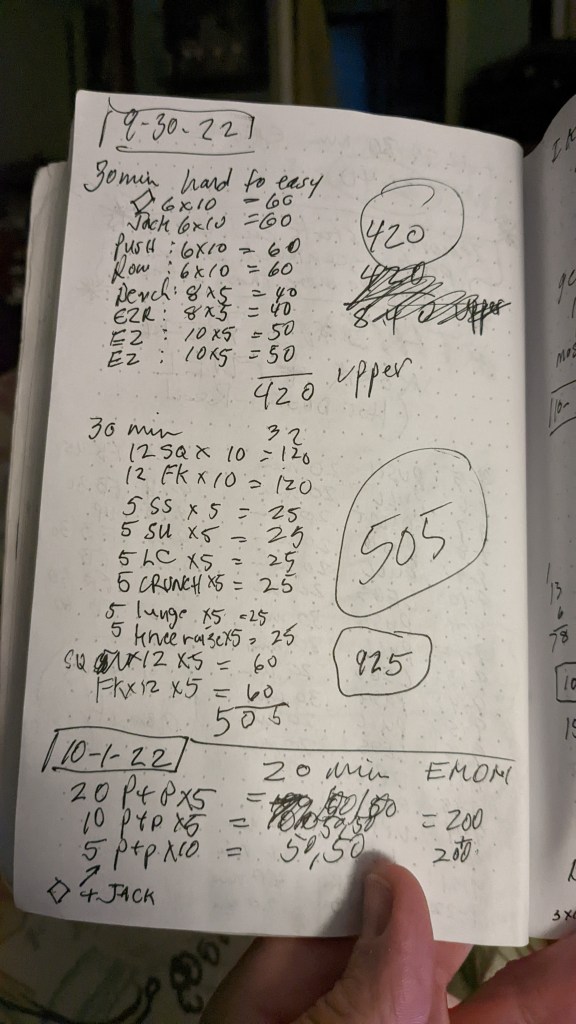
If you keep the volume high and try to keep consistent with your times and rep counts (and feel) you can be creative. No two workouts need be the same unless you are a stickler for measuring progress. Here are a few pages from my shambolic workout journal.

I Gained 2.6 lb. of Muscle Mass in Four Months Using Density Training

In August after my cut, I had an InBody scan at my doctor’s office. I did density training from August to November. I had another InBody scan on 11/17/22 and had increased skeletal muscle mass from 81.4 lb. to 84 lb. Unfortunately my weight and body-fat percentage also increased, so for the current cut I am making a point to keep protein high and calories lower.

An increase of 2.6 lb. of skeletal muscle mass in four months is a strong indicator that density training is a powerful tool for building strength and muscle.

I Lost 20 Pounds in 10 Weeks and Have Kept It Off for 6 More. Here Is Exactly How.

In April of 2022 things had gotten out of hand. Or rather, they’d been out of hand for some time, years, really. I’d had enough. I’m a personal trainer. Should I look like this? I weighed 199 lb. (90kg) with plenty of muscle mass from consistent calisthenics but no muscle definition and way too much fat.

Time to make a change. Finally.

Motivated and informed by the kboges video “Nutrition Principles for Getting Lean and Muscular“, I began in earnest on April 13, 2022 and followed the guidelines closely. This has been my entire summer. And fall.

BEFORE: 199 lb. and about 23% bodyfat on 4/13/2022

The main guidelines: Eat Real Food, Prioritize Protein, Reduce Meal Frequency.

Eat Real Food

You don’t have to be perfect, but the majority of what you eat should be real food. These are things your great-grandmother would recognize as food. It’s a polarized subject and I don’t want to proselytize about diet. I’m an omnivore; I mostly eat plants and I am trying to reduce my animal intake for environmental reasons. I do consume dairy, eggs, fish and seafood. You can certainly obtain the results I got while eating more or less meat than I did and you could do well as a vegetarian, pescatarian, or vegan. Those choices are up to you. Just make sure that most of what you consume is minimally processed, as close to the source as possible, and close to whole as you can get. For me, this includes a wide range of vegetables and fruit, olive oil and sometimes butter, eggs, some grains (usually whole grains), legumes and pulses (big fan!), chicken, fish, shellfish, beef (rarely), and pork (rarely). I should note that I experimented with vegetarianism during the 10 week period and ate no meat for 45 days and had consistent results. Experimenting with vegetarianism, or even just reducing your meat intake to a few times a week, can really help you see plants in a whole new light.

Prioritizing Protein

I don’t like to weigh or measure food, but if you don’t eat enough protein while losing weight, particularly if you don’t do strength training, you will lose muscle mass along with fat. And this is a very bad thing. As my doctor put it, muscle mass is “money in the bank”. As we age, we naturally lose muscle mass anyway. Losing muscle mass is associated with a wide range of problems as we grow older. Whether or not muscle can be gained while fat is lost is a subject of vigorous debate, but at the very least muscle mass can be preserved while fat is lost by strength training and eating enough protein. My rule of thumb is to make the protein the centerpiece of the dish. Vegetables and fruit can be eaten liberally because they are high in nutrients and low in calories, but among the higher calorie macronutrients (to also include fat and carbohydrate), protein should take priority. Examples include meat and dairy (if you are including them), beans and legumes, nuts and seeds, and tofu, tempeh and seitan.

Reduced Meal Frequency

You can call it Intermittent Fasting, Reduced Meal Frequency, Compressed Eating Window, or whatever you want. But the idea here is to not eat all the time. Sounds radical, right? There are many other benefits associated with this particular behavior than just weight loss, so if it’s something you are considering, you should look into it. I would also stress that reducing your meal frequency is by no means required for weight loss. But given that it DOES have other benefits, and one of its main strengths in the context of weight loss is hunger management, it seemed like a no-brainer. I was eating three (unmeasured) meals and at least one (unmeasured) snack before. I reduced this down to two, worked towards making one of them a large, unrestricted feed, and the other a smaller, early dinner. The grand goal was OMAD (One Meal a Day) but I never achieved it. But when I did consistently take one large meal and shortly after one small one, this is when the weight came off rapidly. Under the plan, “lunch” came at about 11:00, then noon, then 1:00 and so on until I was eating my first meal around 3:00 PM. It took me a few weeks to get used to this. This lunch would be as large as I wanted and almost always included a good protein source, lots of vegetables, and lots of fruit. Dinner would be a smaller version of lunch at 5:00 or 6:00. No snacks. Once I got used to it, this was fairly easy.

Training and Walking

Standard strength training for me is 2 or 3 sets of body-weight push, pull and squats per day, each set taken 2-3 repetitions short of failure. At the age of 57, mobility, flexibility and joint health are highly important, so I do most of my work on gymnastics rings or similar suspension trainers. I also work hard to keep my range of motion complete and my technique good. This for me is the gold standard for building and maintaining muscle mass. In addition to strength training, when I started the diet I made sure to get at least 10,000 steps a day, using the Google Fit app on my phone. Once my weight loss plateaued (to be discussed next), I tweaked both the workout strategy and the step goal.

Plateau, Energy Flux, and Maintenance

At about the nine or ten week point, my weight loss stopped. At this point I was at about 179 lb, which is 20 lb lower than when I started. Despite consistency, I did not see further weight loss for a couple of weeks. Additionally, I was feeling tired, unmotivated, and fairly weak. At this point I decided to stop dieting and instead took a “high energy flux” approach. I went back to three meals and snacks as desired (higher energy in) and increased my step goal to 15,000, and moved from intensity towards volume in my strength training (higher energy out). For strength training, instead of three hard sets of push, pull and squat, I moved to total rep goals for the day, which were usually 100-150 push-ups, 50-75 pull-ups and 200-250 squats. I would perform these workouts as quickly as I could with little rest between sets and each set taken far from failure. The goal here is to accrue volume over time. This is Density Training. For example, I might do 15 supersets of (easy) push-ups and rows, 10 reps each, with little to no rest between supersets. This would usually take 20 – 30 minutes. Then for squats I would do at least 20 sets of 10 with a 3-5 second rest between sets or 10 sets of 20 with 15-20 seconds rest between sets. Sometimes I would also do focused core work, such as 100-200 flutter kicks. But I was not consistent with the core work.

The “high energy flux” approach had dramatic effect. That is, I felt suddenly energized and stronger with elevated mood and increased vigor. Workouts were refreshing and I was able to increase reps consistently. As far as weight and body composition, the bad news is that I did not continue to lose weight. The good news is I did not gain weight. My body seemed to have reset itself at about 180 lb and the high energy flux became a sort of maintenance phase after the weight lost.

So these are two extremely potent tools that I was able to develop and are now securely my tool box: real food, protein priority and reduced meal frequency for weight loss and conscientious hunger-based eating and high energy output for maintenance. Moving forward I can pull out these tools and use them as needed. Very simple and reliable.

Vices and “Cheating”

I am lucky to have been born without much of a sweet tooth. Many people struggle with this particular “vice” and I feel fortunate that I can easily resist sweets. I can, however, easily plow through a bag of nacho cheese Doritos or potato chips. I did my best to avoid this for the most part, although a little bit from time to time is fine. It’s very important, I believe, to avoid self-punitive thoughts and Puritanical thinking. This includes things like calling food or eating behaviors “good” or “bad”, “clean” or “dirty”. Even the term “junk” doesn’t really sit well with me, as it will always have you feeling at least a little bit bad about yourself if you “give in”. Improving your body composition should not be about will power and resisting what you really want to do. If you really want to improve your body composition, then really wanting to eat an entire cake or family size bag of potato chips at one sitting really isn’t an option.

A bigger “vice” for me is beer and I’m one of those IPA snobs. It was important to me to see if I could achieve my weight loss goals without having to completely sacrifice this particular habit. Moderation is key of course, but I can safely tell you that if you are aware of your limits, you don’t have to give up everything you enjoy just because it might be considered “unhealthy”. Do not make this a contest of will power.

AFTER: 20 lb weight loss, now at 20% bodyfat

What’s Next?

Through a “high energy flux” approach I’ve been able to maintain my 20 lb weight loss while eating when hungry, stopping before completely full, and continuing to enjoy beer in moderation. How I feel overall has improved dramatically as a result. I’m stronger, the workouts are better, I feel more energy, and my mood has improved.

Time for Round 2. I’m going back to the weight loss eating strategy today and we’ll see how it goes. I’d like to get down to 174, which would be about 25 lb total and I think would allow me to get into the mid teens for body fat percentage. I haven’t been there in a very, very long time.

Bodyweight Squats Will Set You Free

Most people who practice bodyweight squats, or “air” squats, do so briefly. They quickly “move on” to something more “advanced,” after impatiently having asked “how do I make bodyweight squats more difficult?” The expected answers to this question usually involve something like adding weights or working one leg at a time. But to the same question of how to make bodyweight squats more difficult, and without trying to be funny or clever, *I* say “do them correctly and do more of them.” Many, many more.

You see, most people who think they have mastered bodyweight squats can do twenty or twenty-five or maybe more with bad form. And the more they try to do, the worse the form. They do not descend below parallel, and they pop up and down quickly. These are partial reps and are generally done this way out of impatience, inaccurate information (such as that going below parallel is bad for the knees), a lack of mobility and flexibility, an outdated notion that high reps do not build strength and muscle, a lack of understanding about proper technique, or some combination of these factors. In fact, most believe that bodyweight squats are not a “real” or “serious” exercise.

However, of the Big Three Exercises that I perform regularly (the other two being push-ups and pull-ups), squats enjoy by far the highest rep counts per set, yet are by far the most technically challenging exercise that I do. Performed correctly, you should descend below parallel and with a relatively straight back. And you should do many repetitions per set. This requires strength, flexibility, and mobility in the hips, ankles (especially), knees and lower back. It requires quite a bit of practice to master this, and my squats are certainly still a work in progress. I have a long way to go before I master this exercise.

Even if performed correctly and regularly, one can still build up to quite a few squat reps per set, which is not the case for most upper-body exercises. Can you imagine working up to a set of 100 push-ups with good form? Does this fact make bodyweight squats a waste of time? I’d like to suggest here that, rather than being a waste of time, high rep sets of bodyweight squats performed with good technique are liberating, transforming, strengthening, conditioning and worth their weight in gold. And the fact that you *can* perform many reps is what actually makes them absolutely not a waste of time.

Without regular practice I can do a pretty good set of 25-30 squats on demand. WITH regular practice, I have worked up to three sets of 50 reps a day before “moving on to something else”. This is somewhat impressive, especially for a 57 year old, but it certainly stands to reason that I could eventually do more, like working up to three sets of 100. Imagine this. No, seriously, imagine it! Three sets of 100! Although I would not have thought so without a more complete appreciation of this magical and transformative exercise, I now believe that such a goal, three sets of 100 squats a day done with good form, is absolutely a worthy goal.

Here’s why.

The required mechanics to pull off three sets of 100 squats a day make proper technique high rep bodyweight squats the best bang-for-buck exercise of them all in this modern world of epidemic sitting and long periods of inactivity. Everyone sits at a computer all day and on the couch all night. Everyone’s hips are tight. Squats fix this. Everyone’s knees are sore and tight and their legs are weak. Provided you can do them, squats also fix this. Ankle strength and mobility? Lower back? Poor conditioning? Check. Check. Check.

High repetition bodyweight squats performed with good technique require equal parts strength, mobility, flexibility and conditioning. It’s like an entire workout in one exercise. This fact is what really helps to lend the exercise its magic. Mobility work, flexibility work, strength work, and conditioning work all in one move!

Use assistance as you master the form

But the biggest factor that in my opinion makes bodyweight squats singly supreme may surprise you. It’s about the amount of time, consistency and discipline it takes to master the movement and then to work your way up to very high repetition sets. It’s almost like a cure for one of the biggest afflictions we face today – divided attention and lack of focus. How many times have you worked on an exercise or a workout for a while, maybe two or three weeks, and then once the initial excitement and rapid gains wore off, quickly jumped to something else? I have done this so many times I hate to even think about it, and now I can’t help thinking how good I would be at these exercises if I had stuck with them. Jack of all trades and master of none. It’s a little like using a streaming music service versus playing a vinyl record. There are just too many choices. How many times have you jumped away from a song before it’s over just to get to the next one? Is this a healthy activity? Is this listening to music, or are we just getting really good at being impatient and losing focus?

This form (from a few months ago) is about 60-70% there. More ankle mobility will allow more depth and a straighter back. Keep working.

It takes at least a few months to master the mechanics of the squat because so many factors are involved (and I’m not there yet), but because so many factors are involved, mastering the squat pays high dividends. And once the form is good, it takes yet another considerable amount of time to build up to high rep sets. Presently I’m adding about two to five total reps (across three sets) every few days, and my rep counts per set are in the low 30s. And then if I do something that smokes my legs, like play a game of baseball or ride my bike to work and back, I have to dial it back and work back up again. But no worries!

If I get to three sets of 100, and that’s a Big If, that’s 300 reps and right now I’m at about 90. So at this rate it will be at least a month to six weeks to reach the goal, provided I can continue to add three total reps a day. But that’s not likely. There will be setbacks and plateaus. Is this a reason not to do it? Not, it’s a reason TO do it! Once I get there I’ll be at triple my current leg work volume, and who knows how many times my current attention span.

I’m really excited to see where this takes me.